Midea EVOX G3 vs Mitsubishi: Which Heat Pump Fits a Massachusetts Home?
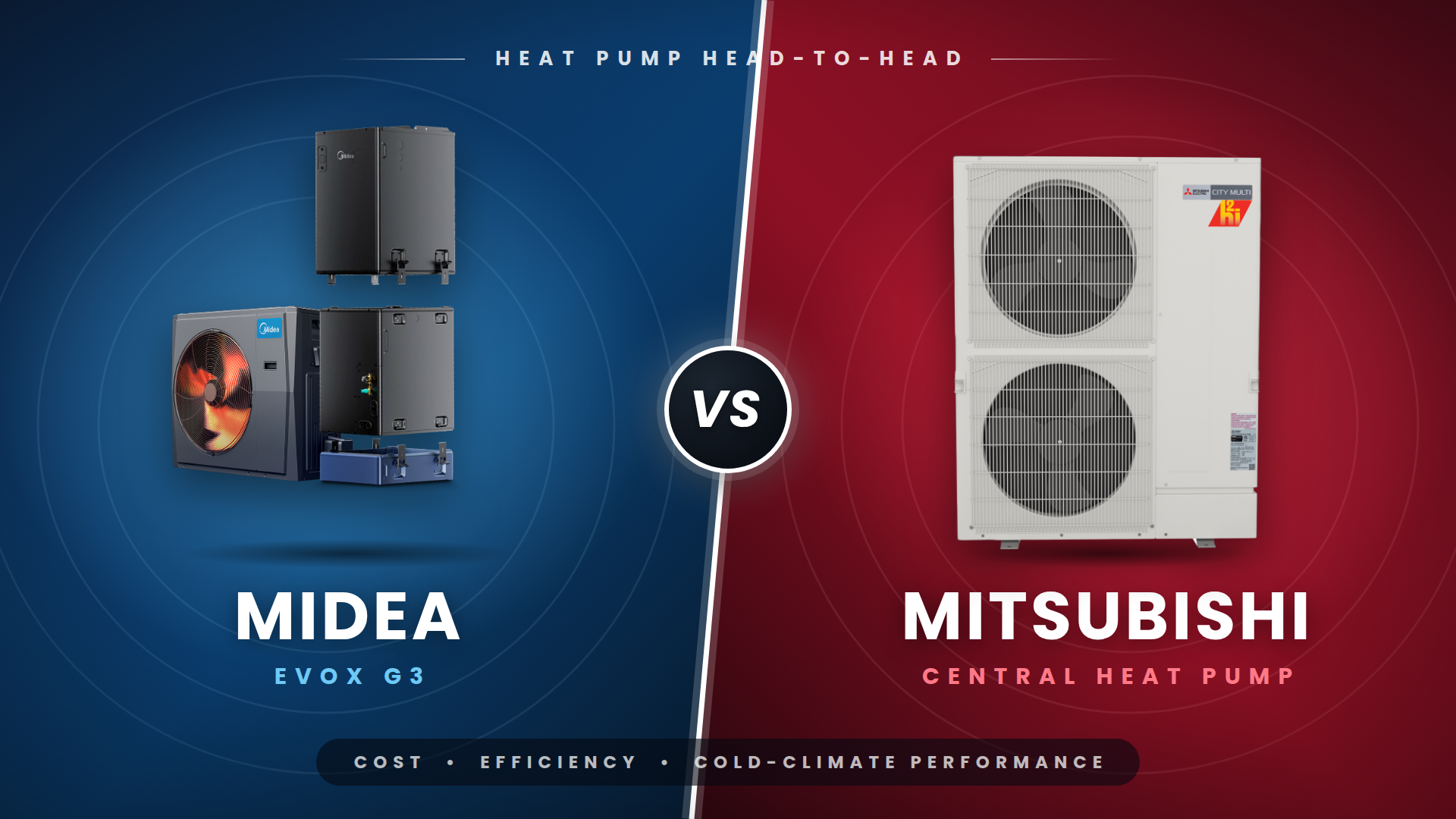
You have two quotes sitting on the kitchen table. One is for a Midea EVOX G3 central heat pump, the other for a Mitsubishi Hyper-Heating system, and the numbers on the spec sheets seem to be arguing with each other. One brochure claims a heating efficiency rating of 12.5 while the other says 10.8, and the salesperson for each insists their system is the better machine. The Midea EVOX G3 vs Mitsubishi question comes up constantly in Massachusetts homes, and most of the comparisons you will find online quietly compare the wrong things. Here is what actually separates them.
The Spec-Sheet Trap Almost Every Comparison Falls Into
Mitsubishi builds two very different categories of equipment. There are ductless mini-splits, the wall-mounted units you have seen in restaurants and finished basements, and there are ducted systems that connect to the sheet metal already running through your house.
The eye-catching Mitsubishi efficiency numbers you see quoted online, the ones in the neighborhood of 12.5 HSPF2 for heating and 20 SEER2 for cooling, belong to the ductless mini-split line. Those are real numbers for real equipment, and ductless Mitsubishi systems earn their reputation.
But the Midea EVOX G3 is a central ducted heat pump. Comparing it to a Mitsubishi mini-split is comparing two different solutions to two different problems. When you look at Mitsubishi's ducted systems, the ones that would actually replace your furnace and use your existing ductwork, the heating ratings land in a considerably different range. Published figures across the ducted lineup run roughly 8.2 to 9.4 HSPF2 depending on model and pairing, while cooling ratings are strong and span a wide band from about 15 to 22 SEER2.
That reframes the conversation. Ducted against ducted, the EVOX G3's up to 10.8 HSPF2 is at the strong end for heating, while on cooling the two lines overlap and certain Mitsubishi pairings rate higher than the EVOX G3's up to 19.0 SEER2. Neither brand sweeps the category. Verify the ratings for the specific model pairing in your quote, since numbers move substantially by tonnage, and insist on a ducted-to-ducted comparison before drawing conclusions.
One More Number Worth Asking About
Published HSPF2 ratings almost always reflect Region IV, the standard climate region used for most of the country. Massachusetts sits in Region V, the colder northern region, and the same equipment rates lower there. Midea, for example, publishes 10.8 HSPF2 for Region IV and 8.8 for Region V on the EVOX G3.
That is not a knock on the equipment. It is how the testing standard works, and it applies to every brand equally. But it means the number on the brochure is not the number that describes your winter. Ask any contractor for the Region V rating on both quotes, and if they do not know what you are asking, that tells you something.
Summer Performance, Which Matters Right Now
August is when a Massachusetts homeowner finds out what their system is actually made of, so start here rather than with February.
The EVOX G3 is rated to deliver up to 100 percent of its cooling output at 110 degrees Fahrenheit and remains operational to 122 degrees. That is an unusually specific published claim, and neither Mitsubishi nor LG publishes a comparable headline figure for their ducted lines, which does not mean their equipment struggles in heat, only that the EVOX G3 documents its high-temperature behavior more openly.
On rated cooling efficiency the two lines overlap. The EVOX G3 reaches up to 19.0 SEER2 with 12.5 EER2. Mitsubishi's ducted pairings span a wide band from roughly 15 to 22 SEER2 depending on model, so certain Mitsubishi combinations rate higher and others lower. Neither brand sweeps the category, which is why the specific pairing on your quote matters more than the logo.
Pay attention to EER2 as well as SEER2. SEER2 averages performance across a season, while EER2 measures efficiency at a single hot condition, so it tells you more about a genuinely brutal afternoon.
Winter Capacity in One Paragraph
Both systems are cold-climate rated, and both will carry a Massachusetts home through winter. The published difference is narrow but real. Mitsubishi's ducted Hyper-Heating systems maintain 100 percent of rated heating capacity down to 5 degrees Fahrenheit and continue operating to minus 13. The EVOX G3 is rated to deliver 100 percent of its heating output at minus 13, with a COP of up to 1.9 there and 2.14 at 5 degrees. Operating at a temperature and holding full capacity at it are separate claims, so ask for the capacity retention curve on whichever model you are quoted.
Where the Midea EVOX G3 Pulls Ahead
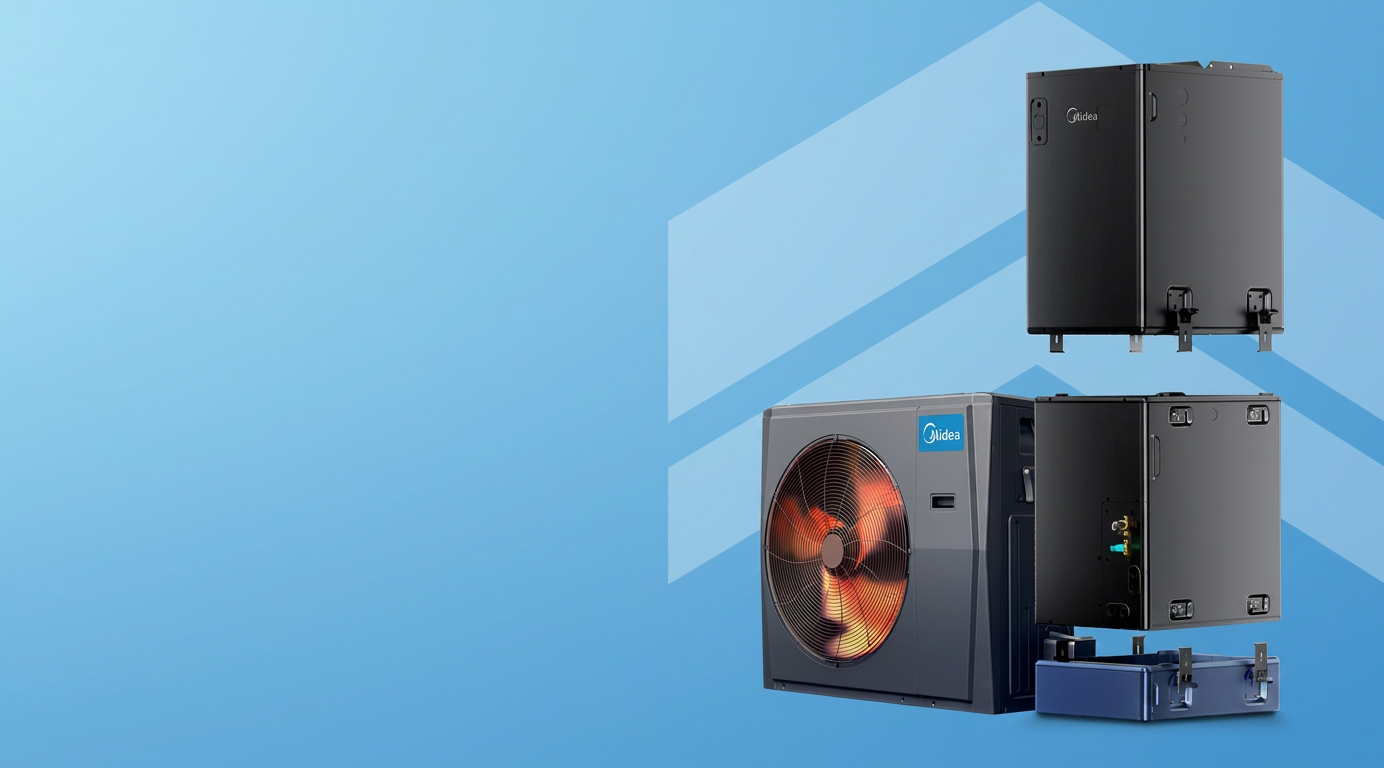
The EVOX G3 was engineered around a specific problem: replacing a gas furnace without tearing your mechanical room apart. It is built as a direct drop-in furnace replacement, matching the width of a typical furnace cabinet and using adaptive voltage so it works across different electrical setups. Its modular latching design lets an installer handle it in sections rather than wrestling one heavy cabinet into a tight basement.
That sounds like an installer convenience, and it is, but it lands in your quote. A retrofit that reuses your existing cabinet footprint and ductwork generally means fewer hours, less custom sheet metal, and fewer surprises once the old equipment comes out. On cooling efficiency, the EVOX G3's up to 19.0 SEER2 also compares favorably against much of the ducted competition, which matters more than people expect during a humid Massachusetts August.
Its capacity range runs from 1.5 to 5 tons, covering the large majority of single-family homes in the state.
Where Mitsubishi Deserves Credit
An honest comparison has to say this plainly. Mitsubishi has been building cold-climate heat pumps for New England far longer than most competitors, and the Hyper-Heating platform has a field track record that newer entrants simply cannot claim yet. That history has value.
Mitsubishi also backs its equipment with long compressor coverage, though the exact term varies by model and generally requires online registration, so confirm the specific warranty attached to your quote rather than assuming. Their dealer network across Massachusetts is dense, and if your home needs a ductless or mixed approach rather than a fully ducted system, Mitsubishi's mini-split lineup is genuinely excellent and posts efficiency numbers the ducted world does not touch.
If your house has no ductwork, or has ductwork only on one floor, that changes the answer entirely.
Refrigerant and Mass Save Eligibility
Both manufacturers have moved to the next-generation refrigerants required for 2026 rebate eligibility. The EVOX G3 uses R-454B, and Mitsubishi's current ducted Hyper-Heating systems use R-454B as well.
This matters more than it sounds. Any heat pump still running R-410A was removed from the Mass Save Heat Pump Qualified Products List as of January 1, 2026, which means an R-410A unit earns no rebate no matter how efficient it is. If a quote lands on your table with a discounted price and an older refrigerant, that discount is almost certainly smaller than the rebate you would forfeit. Confirm the exact model number appears on the current Qualified Products List before you sign anything, verified as of August 2026.
So Which One Belongs in Your House
If you have existing ductwork and a gas or oil furnace you want to retire, the EVOX G3's drop-in design and strong ducted efficiency make it a compelling fit, often at a friendlier installed cost. If you have no ducts, need zone-by-zone control, or place heavy weight on the longest field track record available, Mitsubishi has a strong case.
The real answer depends on your ductwork, your electrical panel, and a proper heating load calculation for your specific house. Any contractor comparing Midea EVOX G3 vs Mitsubishi without measuring your home first is selling equipment rather than solving your problem.
Frequently Asked Questions
Is the Midea EVOX G3 as good as a Mitsubishi heat pump?
For a ducted, whole-home application, the two are much closer than online comparisons suggest, because those comparisons often measure the EVOX G3 against Mitsubishi's ductless mini-split ratings rather than its ducted systems. Ducted against ducted, the EVOX G3 competes well on cooling efficiency and matches Mitsubishi's minus 13 degree cold-climate rating. Mitsubishi holds an advantage in field track record and in ductless applications.
Do both brands qualify for Mass Save rebates in 2026?
Both manufacturers offer current models using R-454B refrigerant, which is required for 2026 eligibility. Qualification is model-specific rather than brand-specific, so the exact model must appear on the Mass Save Heat Pump Qualified Products List, be ENERGY STAR Cold Climate certified, and be installed by a contractor in the Heat Pump Installer Network.
Which system handles a hot, humid Massachusetts August better?
The EVOX G3 publishes up to 100 percent cooling output at 110 degrees Fahrenheit with operation to 122 degrees, a specification Mitsubishi does not feature for its ducted line. On rated efficiency the two overlap, with the EVOX G3 at up to 19.0 SEER2 and Mitsubishi's ducted pairings spanning roughly 15 to 22 SEER2. For humidity control, what matters most is that the system runs long, steady cycles rather than short bursts, which comes down to correct sizing.
Why do Mitsubishi's efficiency numbers look so much higher online?
Because the widely quoted figures usually come from Mitsubishi's ductless mini-split line, which is tested differently and posts higher ratings than any ducted system. Ducted equipment moves air through real sheet metal against real static pressure, which lowers the rating for the same quality of machine. Always compare ducted to ducted.
Trying to make sense of two quotes that do not line up? LaCroix Heating and Cooling has been sizing and installing heat pumps for Massachusetts homeowners since 2012, and we will walk you through the spec sheets honestly, including which equipment actually fits your ductwork and your budget. We are a Mass Save approved heat pump installer, and every installation carries a 1-year installation warranty plus 12-year manufacturer parts coverage. Call or text (508) 762-9131 for a straight comparison.